Factory Scheduling & KPI Reporting API
Full-StackA constraint-based production scheduling service. It accepts a job-shop scheduling problem as JSON, returns a feasible schedule that minimizes total tardiness, and reports KPIs. A React frontend renders the result as an interactive Gantt chart.
View on GitHubOverview
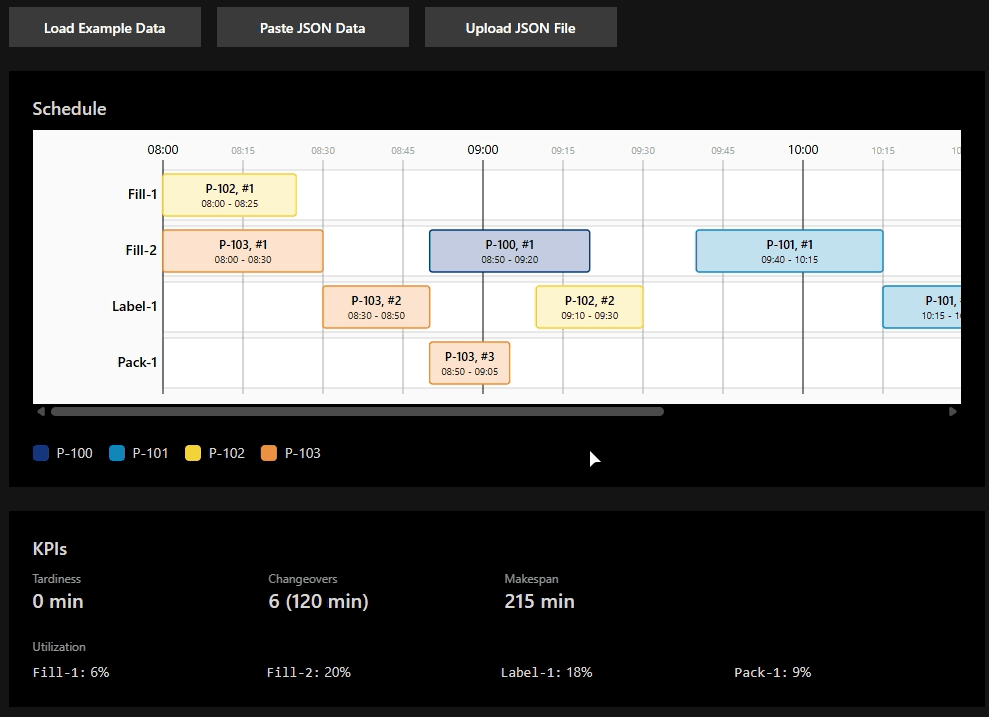
The Factory Scheduling & KPI Reporting service solves job-shop production scheduling as a constraint optimization problem. A client POSTs a scheduling problem as JSON (products, routes, resources, working windows, and due dates), and the service returns a feasible schedule that minimizes total tardiness, along with a set of operational KPIs. A React frontend visualizes the result as an inline-SVG Gantt chart with per-product color coding.
The system is built for extensibility. New client input/output formats, new objective functions, and new constraints each plug in as localized changes to a single file, without touching the solver core.
Tech Stack
| Layer | Technologies |
|---|---|
| Backend | Python 3.12, FastAPI, OR-Tools CP-SAT solver, managed with uv |
| Frontend | React 19 + TypeScript (React Compiler), built with Vite |
| Styling | TailwindCSS v4 + daisyUI v5 |
| Visualization | Hand-rolled inline-SVG Gantt with per-product color coding |
| CI | GitHub Actions runs the test suite on every push and PR |
The Scheduling Problem
The core engine is built on OR-Tools CP-SAT, chosen for its native support for interval variables, no-overlap constraints, and optional intervals. This made it a far better fit than a MIP or a hand-rolled heuristic.
Key modeling decisions:
- Optional intervals. Each operation gets one optional interval per
(resource, working window)pair, with conditional containment enforced viaonly_enforce_if. - Resource selection.
add_exactly_oneover per-resource presence booleans. - No-overlap.
add_no_overlapper resource across all windows. - Family-dependent changeovers. The standard disjunctive pattern: one boolean per unordered pair selects ordering, and the setup constraint for the chosen direction is enforced.
- Tardiness.
tardiness >= last_op.end - due, lower-bounded at zero, summed, and minimized. - Determinism. A single search worker and a fixed random seed yield byte-identical output across runs.
Architecture
The system enforces a strict separation between canonical types (client-agnostic, used by the solver, KPIs, and validation) and adapter types (client-specific JSON shapes). Everything downstream of the adapter speaks the same vocabulary, regardless of which client sent the request.
A POST /schedule request flows through six stages:
- Parse. The client adapter validates the JSON shape (Pydantic) and translates it into the canonical
SchedulingProblem. - Diagnose. Pre-solve structural checks flag common infeasibility causes (missing capabilities, windows too short, demand exceeding capacity, impossible deadlines) and short-circuit to a
422with concrete reasons. - Solve. CP-SAT builds the model by walking the constraint registry, applying the selected objective, and solving. It returns a canonical
Solution. - Compute KPIs. Tardiness, changeover count and minutes, makespan, and per-resource utilization.
- Validate. The validator re-walks the constraint registry, independently re-checking each invariant against the final solution to catch solver bugs.
- Format. The adapter translates the canonical solution and KPIs back into the client's response shape.
Three plug-in registries follow the same pattern: adapters/ (one file per wire format), objectives/ (one file per objective function), and constraints/ (one file per hard constraint). Adding a client, objective, or constraint is a localized change.
KPIs Reported
- Tardiness. Total minutes late across all products.
- Changeover count & minutes. Family-boundary setups on each resource.
- Makespan. Latest end minus earliest start.
- Per-resource utilization. Processing minutes over horizon-clipped calendar minutes.
Frontend
The React frontend lets a user load the spec's example problem or upload a custom JSON payload, then renders the returned schedule as an inline-SVG Gantt chart with per-product color coding. The backend is fully usable on its own, via curl, Postman, or the auto-generated Swagger UI, without ever running the frontend.
Robustness
The service distinguishes three failure modes by response shape:
422infeasible. The problem genuinely cannot be solved. Thewhyfield lists concrete, actionable reasons.400bad request. Client-side input errors, such as an unknown objective mode.500invariant error. A post-solve validation failure, representing a solver or model bug rather than user input.
The test suite, run automatically in CI, covers a validation invariant test, a KPI math test, and an infeasibility test, mirroring the three tests required by the project spec.